
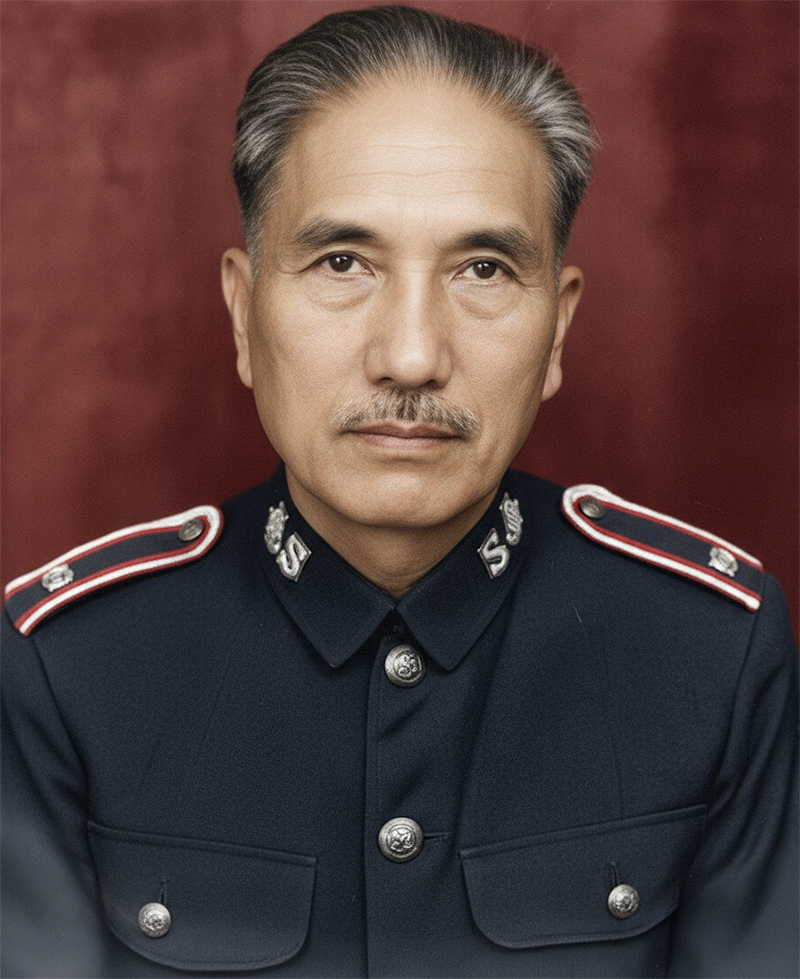
Kawl Khuma
Kawl Khuma, born in 1890, was raised with the belief in spirits that surrounded his village—spirits that needed to be appeased with offerings of cocks, pigs, and other animals. It wasn't until he attended school in Aizawl that he first heard the Christian gospel. The words of the Mizo pastor resonated deeply with the 14-year-old boy, leading him to decide to become a Christian.
After passing the middle school examination in English, he was accepted for training as a compounder at the local civil hospital. In his spare time, he travelled from village to village with a Christian friend, preaching the gospel of Christ and winning many converts. One day, while sitting among a group of Christian friends, Kawl Khuma suddenly exclaimed, "Let us form ourselves into an association of Christians and draw up a special set of rules to guide our lives. We could all live together in a separate community, and to give a better witness, I think we should wear uniforms." After discussing the idea, they decided that their uniform would consist of a khaki coat with a piece of red cloth sewn onto the upper edge of the breast pocket.
He was informed that their association resembled The Salvation Army. Having studied English, he had no difficulty explaining it to his friends, and they reacted with curiosity, asking, "How can we contact The Salvation Army?" Someone mentioned Booth-Tucker as the leader and that the headquarters were located in Simla in northern India. Kawl Khuma decided to write to him. When the reply came with an invitation to visit Simla, Kawl Khuma and his friend Pu Chalchhuna, with whom he had formed the group of uniformed Christians, decided to make the journey together.
Unfortunately, Chalchhuna's health began to deteriorate. He was admitted to the hospital, where the doctor diagnosed him with double pneumonia. On the seventh day, Chalchhuna passed away. He received an Army funeral, and Salvationists supported Kawl Khuma during the loss of his dear friend.
A few days later, Kawl Khuma was summoned to Commissioner Booth-Tucker’s office. The Commissioner asked, "Are you willing to travel to Bombay and undergo training in The Salvation Army training home, then dedicate your life to service for God in the Army?" Having witnessed the Army up close, Kawl Khuma's determination to become a Salvation Army officer intensified. He set out alone on the two-day journey to Bombay.
Kawl Khuma had a singular goal: to establish The Salvation Army's work among his own people. However, Army leaders were uncertain if the time was right, as two other missions were already operating in the area, and they did not want to create discord. On the day of commissioning, when the cadets accepted their appointments, Kawl Khuma was assigned to the criminal tribes’ settlement in Gorakhpur. Convinced that God intended him to preach to his own people, he wrote to Commissioner Booth-Tucker, who allowed him to return home.
Upon arriving in Aizawl, Kawl Khuma was warmly welcomed by family and friends, all eager to hear about his experiences beyond the hills, especially regarding the international Chhandamna Sipai. Not long after his return, he received a letter from Colonel Sukh Singh (Blowers), Chief Secretary for India and Ceylon, stating:
"As we are unable at present to officially commence Salvation Army work in your district, we advise you to return to your former occupation. You will still retain your rank of Lieutenant, but we will not be able to provide you with any remuneration. However, we will constantly pray for you, that the Lord may use you mightily in His service."
The purpose of this letter is to address the government's refusal to allow more than two existing missions to operate in Mizoram. Kawl Khuma believed that God had directed him to The Salvation Army, and he wanted to work within that framework. Many of his friends encouraged him, and together they constructed two large communal houses made of bamboo and grass in Sawleng village. To support themselves, they acquired two pack animals and established a transport business to carry rice and other products for sale in Aizawl. Kawl Khuma was appointed to manage the business.
Despite this, he found the most joy in marching from village to village with a Salvation Army flag held high on a bamboo pole, conducting meetings in true Salvation Army fashion. He even obtained a drum, which delighted the music-loving Mizo people. Behind the beat of the drum and the flag, they visited Aizawl, and a revival spread throughout the hills, leading thousands to embrace Christ.
Kawl Khuma understood that instruction in the new faith was vital for nurturing strong Christians. He wanted every convert to have a copy of the Handbook of Doctrine and Orders and Regulations for Soldiers in their own language. The Salvationists gathered for a conference and decided to assign someone else to run the transport business, allowing Kawl Khuma to focus on translating the books. He also translated Salvation Army songs into Mizo.
In April 1921, upon hearing about the establishment of a training home in Calcutta, Mizo Salvationists applied for admission for some of their young men. Under Kawl Khuma’s leadership, six candidates were accepted. Upon their return to Mizoram, they established six corps, which led to the creation of 31 outposts in neighbouring villages.
A year later, Kawl Khuma was called to Calcutta due to complaints that Salvationists were causing disturbances by interfering with established churches. Headquarters was advised to withdraw its forces.
Several months later, in late 1924, the Territorial Commander of the Eastern India Territory, accompanied by Kawl Khuma and two missionary officers, undertook a week-long journey from Calcutta to Aizawl to investigate the allegations. Interviews were conducted with leaders from the Welsh Presbyterian Church. The complaints proved to be unfounded, and the authorities lifted some restrictions, allowing the officers to resume their ranks and wear their uniforms. Headquarters further advised the officers to take responsibility for the work in their home villages. A salt-selling business was organized by the Salvationists to support their efforts.
In April 1925, Kawl Khuma was transferred from his appointment in Bengal and returned to Mizoram to strengthen and encourage the faithful Salvationists. However, it wasn't until early 1928 that the government officially permitted The Salvation Army to operate in Mizoram.
By 1945, Mizoram had grown to 30 corps and was designated a division, with Brigadier Kawl Khuma serving as the divisional commander.
In 1959, Brigadier Kawl Khuma left Senior-Major Coxhead in charge of the 39 corps that had been established and set out to pioneer work in Cachar, Assam. The district was experiencing political upheaval following the partitioning of nearby East Pakistan from India, resulting in thousands of Hindu refugees flooding the town of Silchar, the capital. Communal strife between Hindus and Muslims often turned violent. Despite facing these challenges at the age of 60, Kawl Khuma remained undaunted, even as a language barrier complicated matters. Once the situation stabilised, he reached out to Mizo’s who had moved to the district and also began work in Manipur. When he returned to Aizawl to retire in January 1956, he left behind an active soldiers’ roll of 400 names.
In 1966, General Frederick Coutts admitted Lieut. Colonel Kawl Khuma (Retired) to the Order of the Founder.
Source: By Love Compelled – by Solveig Smith


