
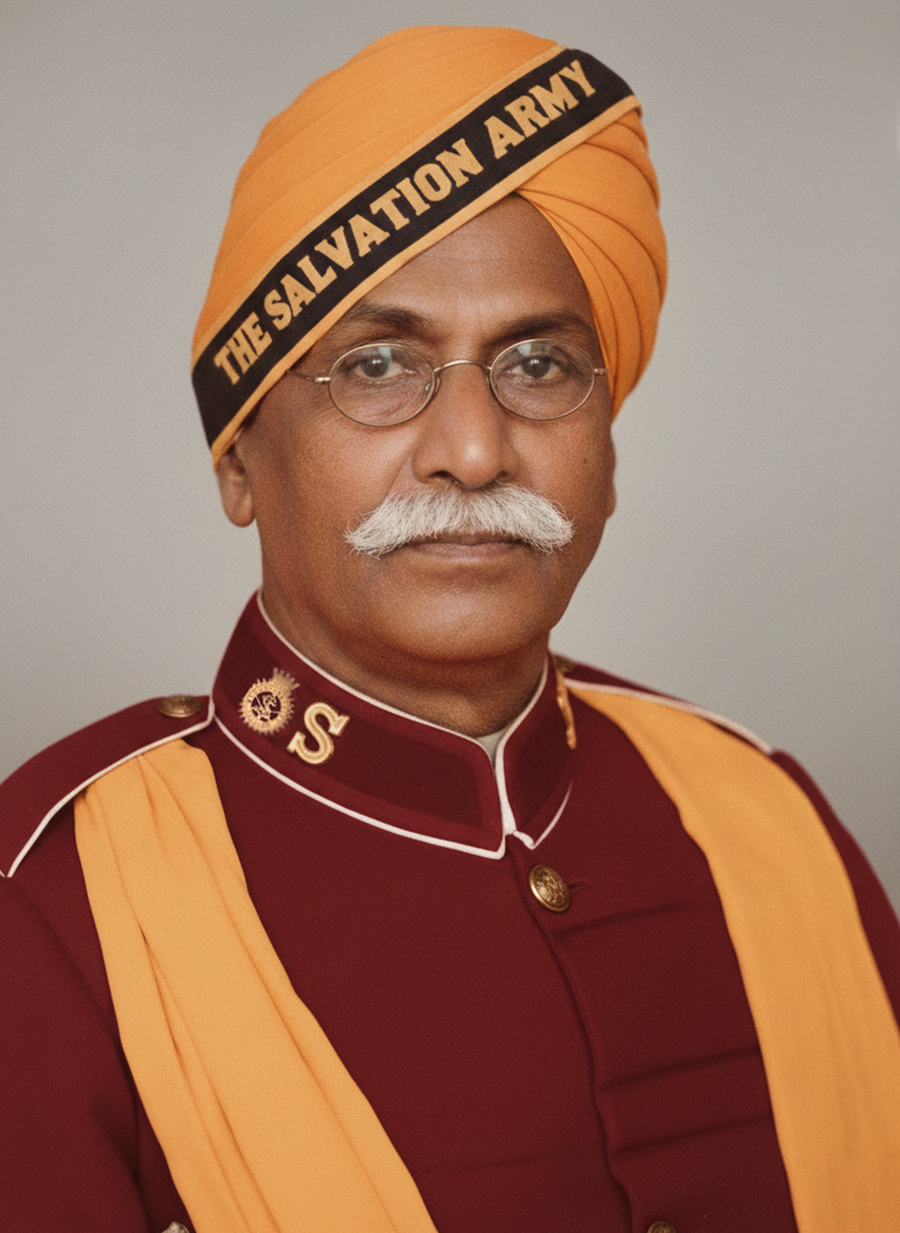
Born in 1872 at Palamcottah, Tamil Nadu, of high-caste Hindu parents, he was early trained by his mother, himself becoming a zealous Hindu and, despite education at a missionary high school, developing a deep antagonism to Christianity.
With other young boys, he threw stones and caused disturbance when, in 1889, the then Staff-Captain Millner, assisted by two or three officers, commenced Salvationist operations in his native town. Eventually, challenged by an Indian officer in an open-air meeting, he decided for Christ in the presence of a number of his former co-religionists. He had been greatly affected by the prayer-life of the missionary officers, as he noticed their wrestling for the souls of his people, and by their willingness to give up home and friends and even resort to a local manner of dress and habit to win Indians for Christ. Also, the remarkable change in the lives of certain young men he had known and who became converted in the Army influenced him deeply.
At first persecuted and finally disinherited by his family, he entered training from Palamcottah in 1899. During his cadetship, he suffered imprisonment for engaging in open-air work. One of the significant victories he won as a cadet was the overcoming of the age-long prejudice of eating food with, and prepared by, people of a lower caste than himself and sometimes of no caste.
Appointed to the city of Tanjore as an assistant to the officers who had been the means of his conversion, he began the series of appointments which he was to hold in Travancore, Telugu, Gujarat, United Provinces, Marathi country and the Punjab, becoming eventually the first Indian officer to rise to the Army’s highest rank of commissioner. He retired in 1938.
Major Herbert Mitchell wrote of him at that time:
‘If you ask me what I consider his outstanding characteristic, I would reply, his religion. In this, he worthily represents the distinguishing quality of his race, but his early devotion to the Hindu faith had been replaced by an all-embracing love for God as revealed to him in Jesus Christ. With the Commissioner, prayer is as natural and necessary as breathing. He loves God’s Word and reads it diligently. He delights to tell of his conversion. His religious habits impart a quality to all the activities of his life.
For many years, the Commissioner has borne the burdens of territorial leadership, and he has been an inspiration and blessing to many. Hundreds of Indian officers have looked up to him as a worthy example, and non-Indians have found in him a leader and a friend they could trust.
The Commissioner would be the last to claim that his natural endowments included all the highest qualities of leadership, but a combination of natural gifts and divine empowerment has enabled him to discharge his high responsibilities with ability, dignity, and success.’
Mrs Muthiah, whom the Commissioner married as Ensign Nirmala in 1906, was promoted to Glory in 1948.


